- The Bible
- The Picture
- The Letter
- The Ravine
- The Telegram
- The Notice
- The Brother
- The Choice
- The Trunk
- The Catch
- The Glue


The Picture
Every morning, Belle reached for her glasses, then turned her eyes to the photo in its modest gold frame. It sat on the bedside dresser beside her, quietly aging with her.
The black-and-white portrait showed a young man standing by a riverbank, dressed in uniform, one hand in his pocket, eyes shaded by sunglasses—caught forever between the ease of youth and the weight of duty. The edges of the photo had softened with time, like a memory worn thin from too much handling.
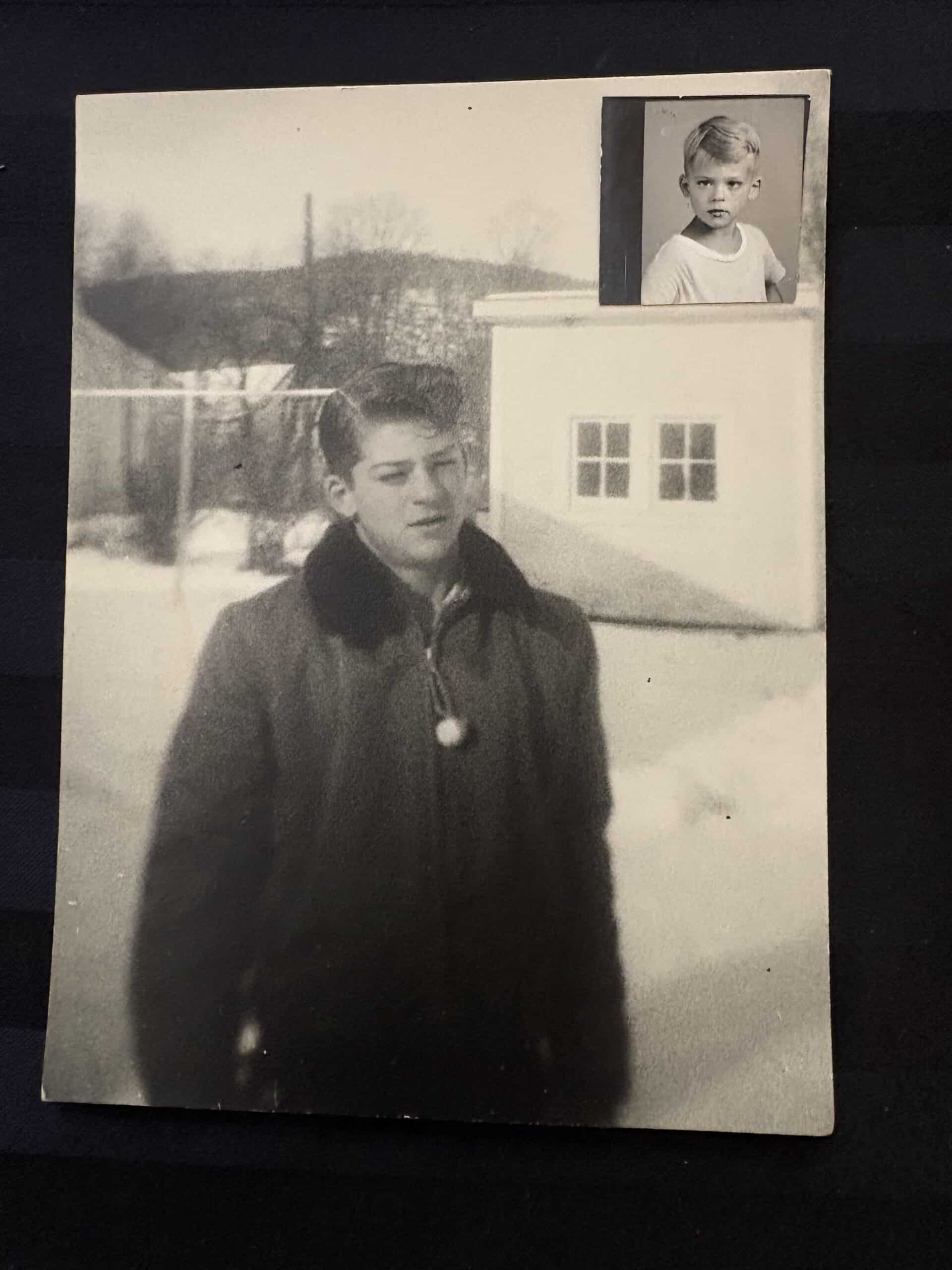
And tucked carefully into the frame—a small photograph, slightly faded now—was Leland as a boy. No more than six or seven, in a sailor-striped shirt, smiling softly. The child he had been, placed forever beside the man he would never fully become.
Belle would sometimes cradle the frame. She didn’t pick it up. She never did. That small square of heaven had lived beside her longer than anyone else.
Forty-one years, she reminded herself. Her son had been gone for forty-one years—a number that didn’t feel real, and never would.
His name was Leland Blakeslee. Her third of four children. The boy who had gone off to war—and never come home.
Killed in action in Korea, November 2, 1950. Age nineteen.
The military had returned only a name—folded in a flag, carved in stone, spoken on certain holidays—but not the son she had loved.
Every Sunday, Belle dusted the frame and straightened it, just slightly. Every year on his birthday, she laid a single daisy in front of it—his favorite flower, from childhood summers spent in the fields near home. And every night, before turning off the light, Belle looked into his eyes—those calm eyes, behind the soldier’s sunglasses—and whispered:
Goodnight, son. I love you.
She never expected an answer. But in her heart, she believed he heard.
The room around her had changed. The walls had been repainted once, then faded again. Furniture had come and gone. Visitors—family—stayed in the guest room now and then, always commenting on how little had changed in Belle’s bedroom.
The truth was, she had stopped changing anything after 1950.
To visitors, the space may have seemed old-fashioned, out of step with the passing years. The gold frame itself—a thin, worn edging, corners slightly bent—matched the gentle weight of time in the room.
Her own portrait, in a heavier, newer frame, sat nearby. The contrast told its own story: lives that had moved forward, and a life forever paused. Belle didn’t consider the photo a shrine. There were no candles, no locked doors, no braided ropes. Just a picture by her bedside—the young man and the boy he had been, side by side beneath the glass—and the quiet weight of a mother’s promise kept.
He was still here.
Breathing with her, through the silence of the room.


The Letter
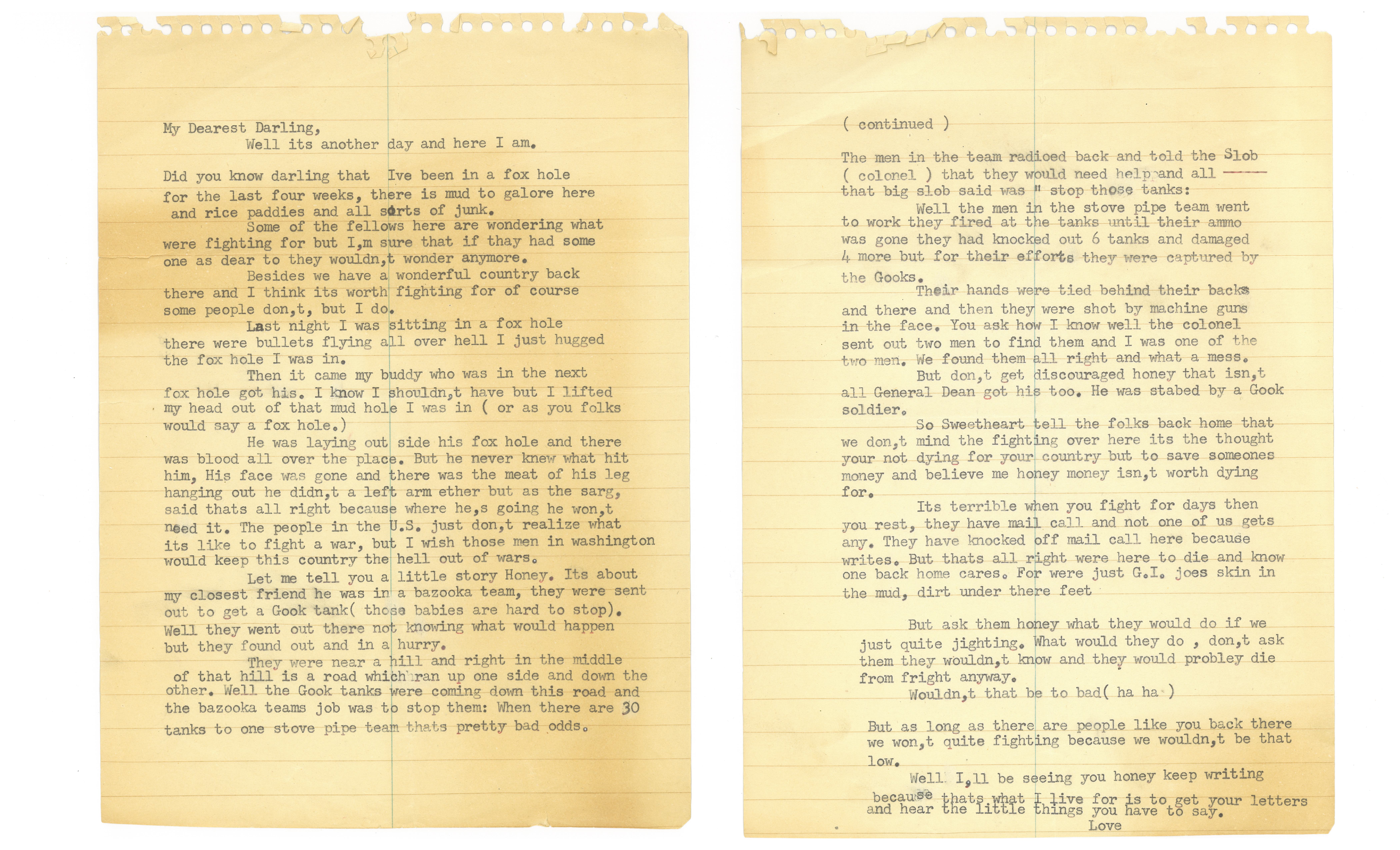
This letter was written by Private First Class Leland Blakeslee on the frontlines of the Korean War and addressed to his childhood sweetheart, Helen. Typed on yellowed paper now stained with age, it captures a raw and haunting glimpse into the experience of a young American soldier in combat.
Leland describes life in a muddy foxhole, the constant fear of enemy fire, and the devastating loss of friends beside him. His tone is intimate yet unflinching. He recounts the death of a fellow soldier in harrowing detail and reflects on the futility and waste of war—even as he affirms his belief in the country he’s fighting for. Through the story of a bazooka team ambushed while facing overwhelming odds, he lays bare the horror and injustice of battle.
Yet even amid the chaos, Leland’s affection for Helen shines through. He longs for her letters. He finds purpose in her love. And despite everything, he urges her not to worry—offering a tender lie to shield her from the truth.
It is a letter written in the mud but aimed at the heart. The voice of a boy trying to sound like a man. A love letter wrapped in war. A glimpse of the life he might have lived.
The Ravine
The cold was everywhere. Leland felt it through his gloves, his boots and the layers beneath his field jacket. Each breath hurt. Gunfire echoed across the hills, some of it close enough to tear into the ground around them, some of it farther away where other men were still trying to hold their positions.
Chinese forces had surrounded the 3rd Battalion of the 8th Cavalry Regiment. There would be no reinforcements. No rescue. The men of K Company were on their own.
Leland moved with what remained of his unit through a narrow pass cut into the Korean earth. He held the Browning Automatic Rifle against his shoulder. The barrel was hot from firing, but his hands were nearly numb. Smoke hung between the trees, and men appeared and disappeared inside it as they moved. No one spoke unless he had to. There was little left to say.
A burst of gunfire struck nearby. Leland turned toward the sound just as something hit the burned frame of a jeep beside him. Another burst followed, and a sharp pain tore through his side and threw him against the metal. His helmet came off, and the rifle slipped from his hands.
For a moment, he remained upright, trying to understand what had happened. Then his legs gave way and he fell onto the frozen ground. He pressed his hand against his side. When he pulled it away, the glove was covered with blood.
Someone shouted his name, but he could not tell from where. The gunfire had become muffled beneath the ringing in his ears. He tried to push himself up, but his arms would not hold him.
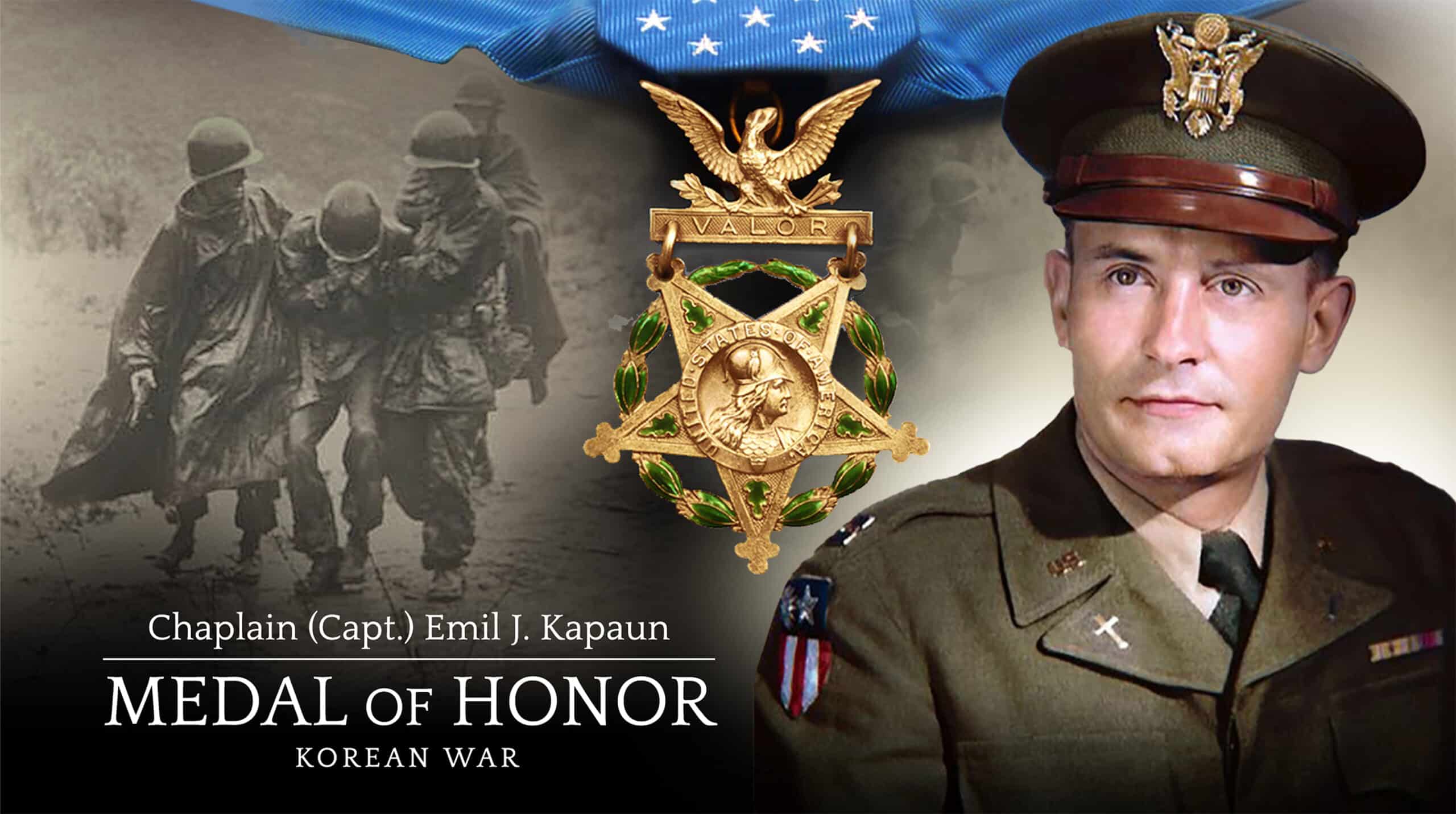
A figure came through the smoke, bent low beneath the gunfire. Chaplain Emil J. Kapaun reached him and dropped to his knees. His glasses were cracked, one lens missing. His chaplain’s stole hung loosely from his neck, stained with dirt and blood.
A bullet struck the ground nearby and scattered dirt across them, but Kapaun stayed where he was. He placed one hand behind Leland’s head.
“Son,” he said. “I’m here.”
Leland tried to answer, but nothing came out.
“You’re not alone.”
Kapaun reached inside his jacket and removed a small silver pyx. Then he touched two fingers to Leland’s forehead and began the prayer.
“In nomine Patris, et Filii, et Spiritus Sancti…”
“I absolve you of your sins,” Kapaun said quietly, “and commend your soul to the mercy of God.”
Leland looked up at him. The fear had not disappeared, but something in Kapaun’s voice steadied him. His hand moved toward his pocket and closed around the harmonica.
He thought of home. He saw 65 Plum Street and the porch in summer. He thought of Helen’s face beneath the stars.
In his final moment of consciousness, he whispered, “Mom.”
Then everything went black.
No one knows where Leland fell, who was beside him or what passed through his mind in the last moments of his life. What is known is that Chaplain Kapaun was with the surrounded men of the 3rd Battalion on November 2, 1950. He moved through enemy fire, tended the wounded and refused to leave the men who could no longer escape.
Perhaps, somewhere in the smoke and confusion, he reached Leland. Perhaps the nineteen-year-old boy from Bolivar did not die alone.
That can only be imagined. What happened to K Company cannot. The men were surrounded, outnumbered and running out of ammunition. Some were killed where they fought. Some were wounded. Others were taken prisoner. By the end of the battle, the company Leland had entered Korea with ceased to exist.
Kapaun was captured that same day and taken to a prison camp. There, he shared his food and clothing, cared for the sick and helped men who could no longer walk. He defied the guards and sustained prisoners who had begun to lose hope. He died in captivity on May 23, 1951. More than sixty years later, he was awarded the Medal of Honor.
Leland’s real story ended at Unsan. He was nineteen years old. His body was never recovered. His family received a notice, and then they were left with the things that remained: his photographs, his letters and the memory of the life he had barely begun.
That is where history leaves him.
But what if his chest rose once, and then again? What if a medic reached him before the darkness did? What if someone saw the slightest movement and shouted for a stretcher?
“This one is still alive.”
Leland’s hand remained closed around the harmonica as his eyes opened. He did not die in the ravine.
He was carried from the field, wounded and nearly frozen. By morning, he was a prisoner, beginning a march into captivity that would test him in ways the battlefield never had. Behind him, Chaplain Kapaun remained with the wounded men of the 3rd Battalion. He stayed with them until there was no one left to save.
Two men left Unsan as prisoners. Only one would come home.
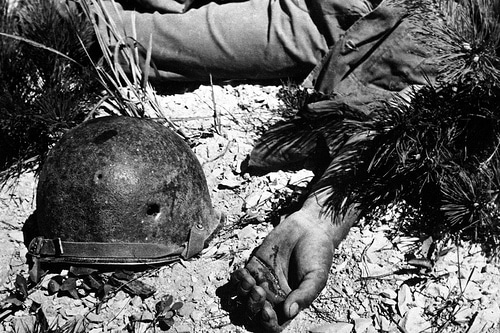
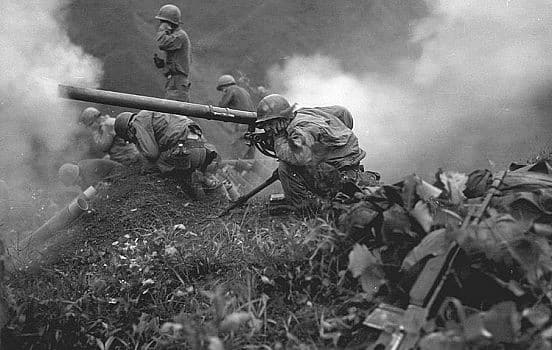
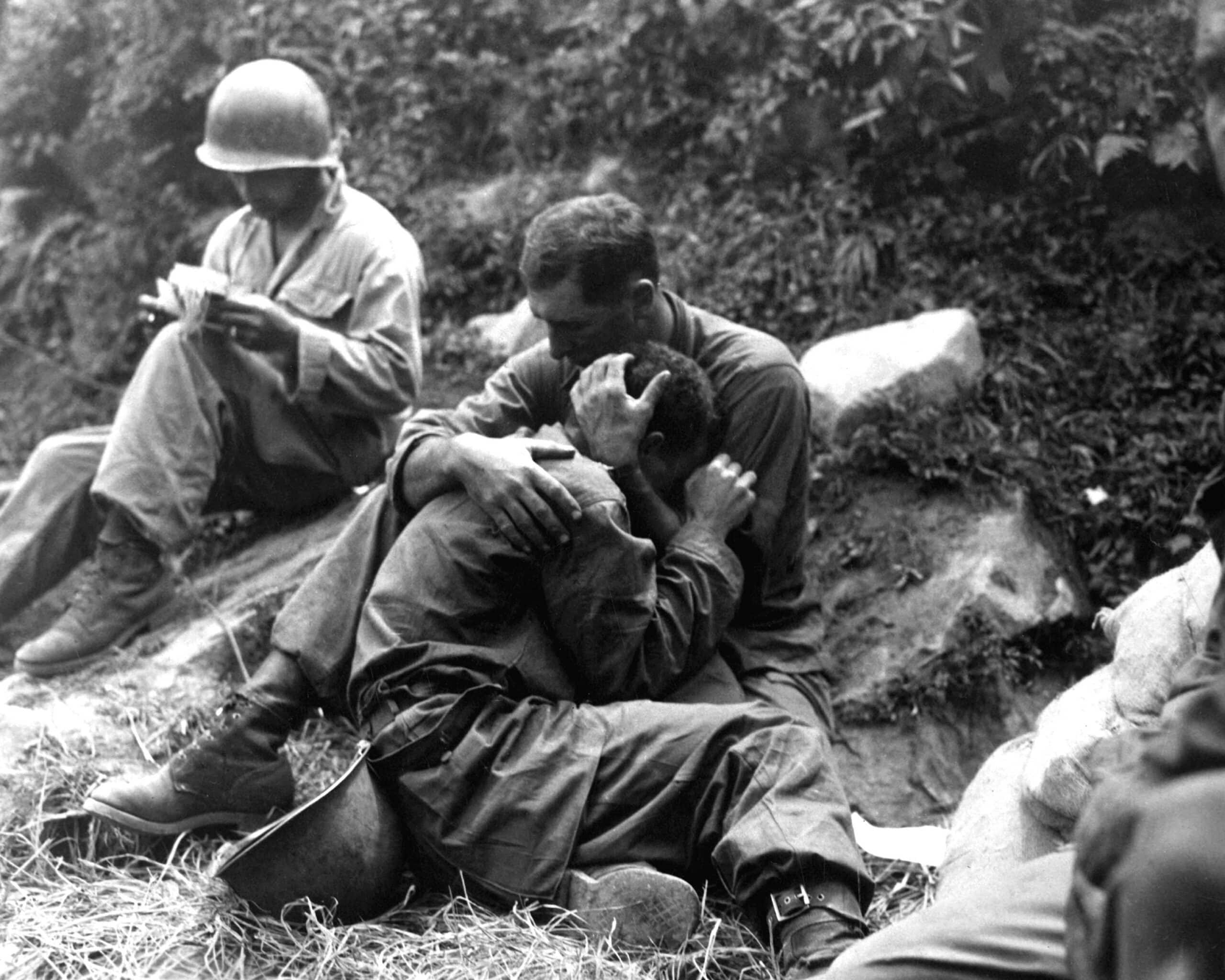
NARA FILE # 080-SC-347803
WAR & CONFLICT BOOK #: 1459
The Telegram
Every war has a moment that never makes the history books.
It doesn’t happen on a battlefield.
It happens at a front door.
A knock.
A car pulling up.
A man standing there with something no parent ever wants to see.
For the parents who receive it, time stops in that instant—before a word is spoken, before the envelope is opened. Because somewhere deep down, they already know.
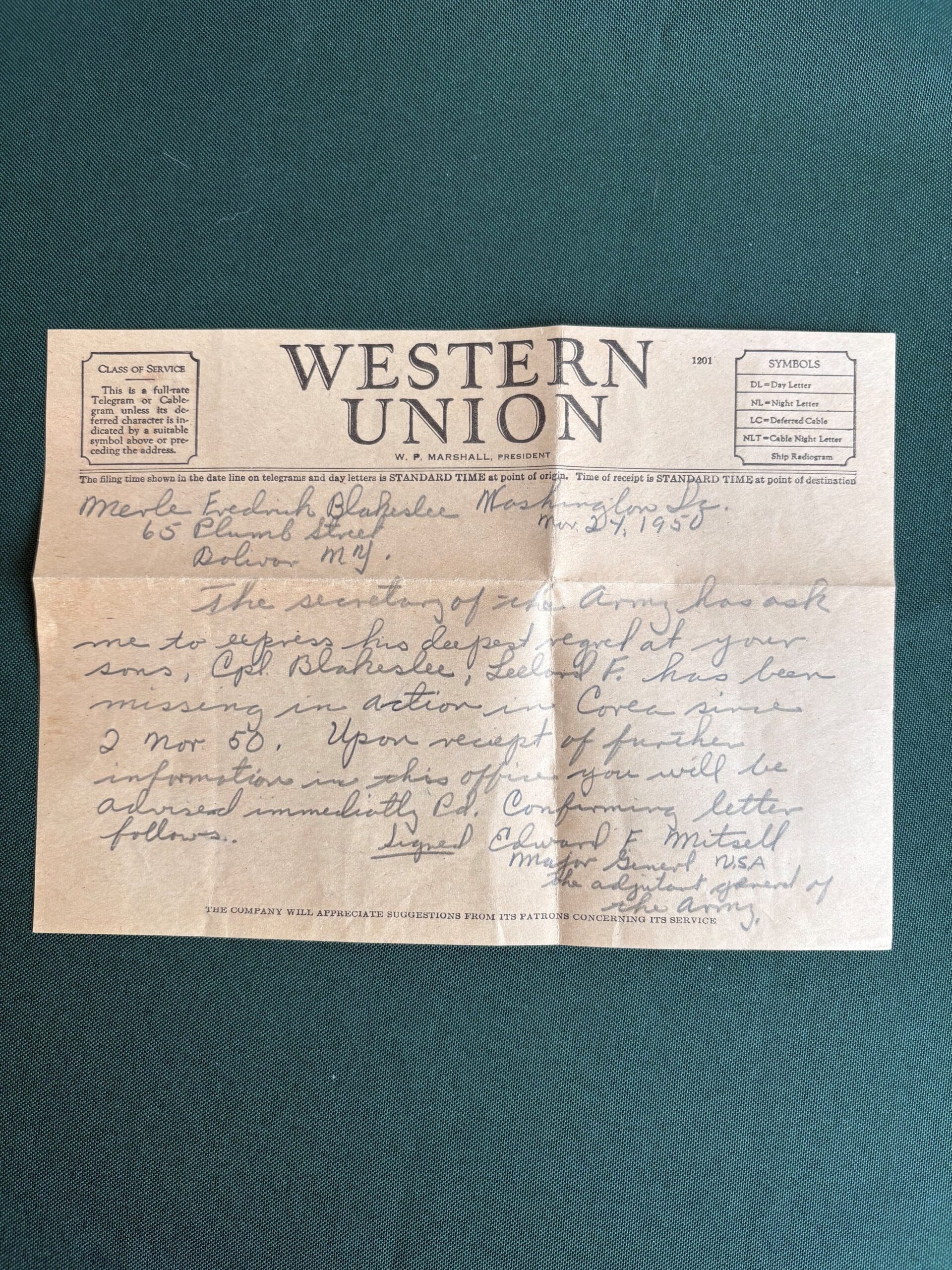
For the Blakeslee family, that moment came on November 24, 1950.
The message arrived as a Western Union telegram—formal, restrained, almost clinical in tone. But behind every word was something no message could fully hold.
A son.
A future.
A world that would never be.
Not loud.
Not dramatic.
Just a few words, carefully written, carrying the weight of a life.
Hope changed.
Not gone—just no longer certain.
Uncertainty took its place.
Days that would stretch into years.
A silence that would never go away.
This is what every parent dreads.
The Notice
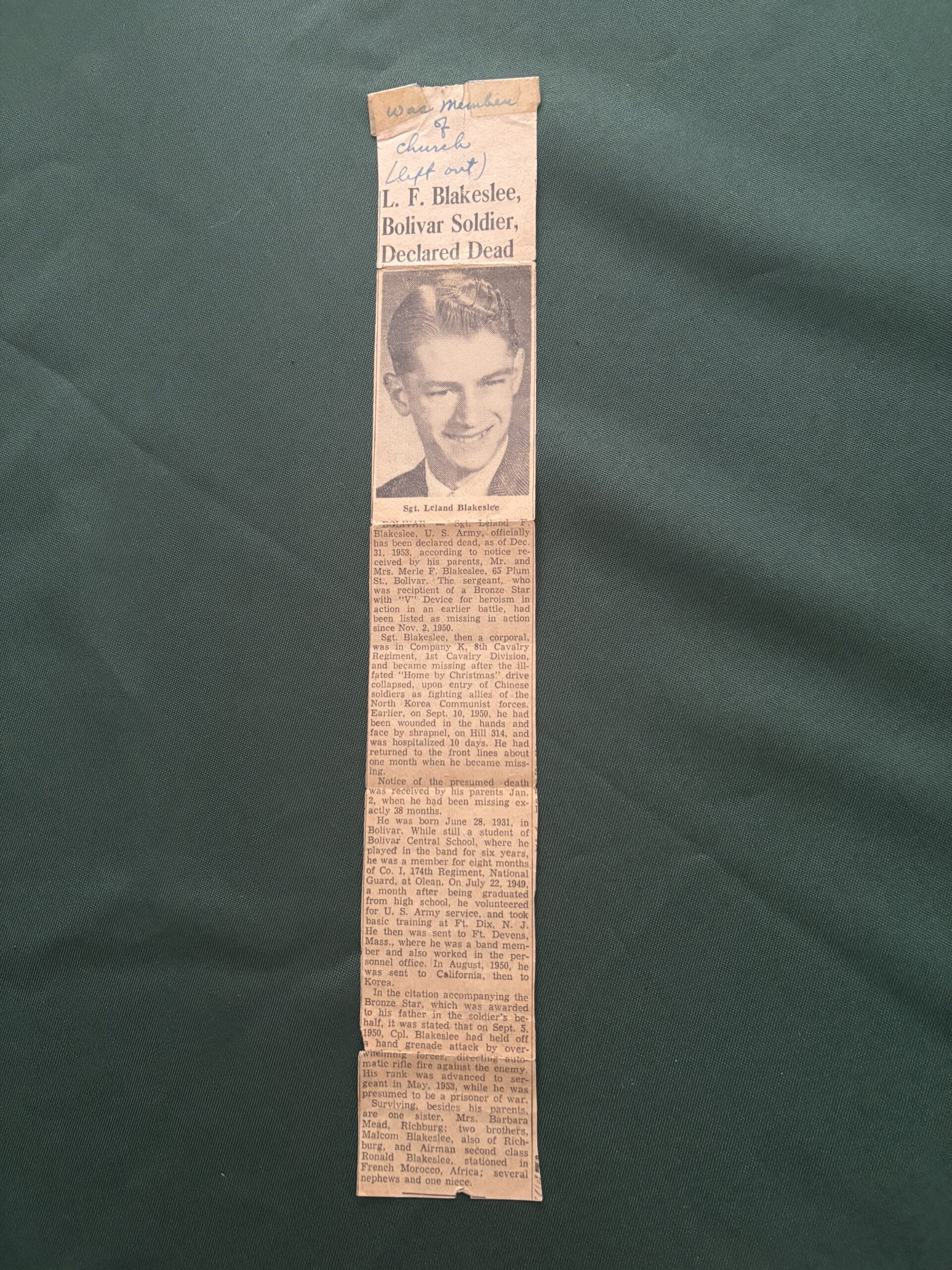
On December 11, 1953, after more than three years missing in action, the U.S. Army officially declared Sgt. Leland F. Blakeslee dead.
The young man from Bolivar, New York, had disappeared in the chaos of battle near Unsan, North Korea on November 2, 1950. He was just 19 years old.
The announcement arrived not as a surprise, but as a heartbreak long expected. Leland had been missing for more than 36 months—through holidays, birthdays, and seasons that changed without him. For his family, the telegram merely confirmed what their grief had already come to understand.
Leland Blakeslee was born on June 28, 1931, in Bolivar. He was the kind of student who left a mark—editor of the high school yearbook, an athlete, a musician in the band, a captain in the National Guard. Just days after graduation, he enlisted in the Army and volunteered for combat.
He was awarded the Bronze Star for heroism under fire—holding off a grenade assault by overwhelming enemy forces on September 8, 1950, just weeks before he vanished.
Leland’s death was never witnessed. His remains were never recovered. But those who knew him carry no doubt about the kind of man he was. In life, he was a son, a brother, a sweetheart, a soldier. In death, he became something else: a symbol of sacrifice, youth cut short, and love left behind.
A handwritten note on the newspaper clipping reads:
"Was member of church. Left out."
Even now, the small omissions matter. Because Leland mattered.

The Brother
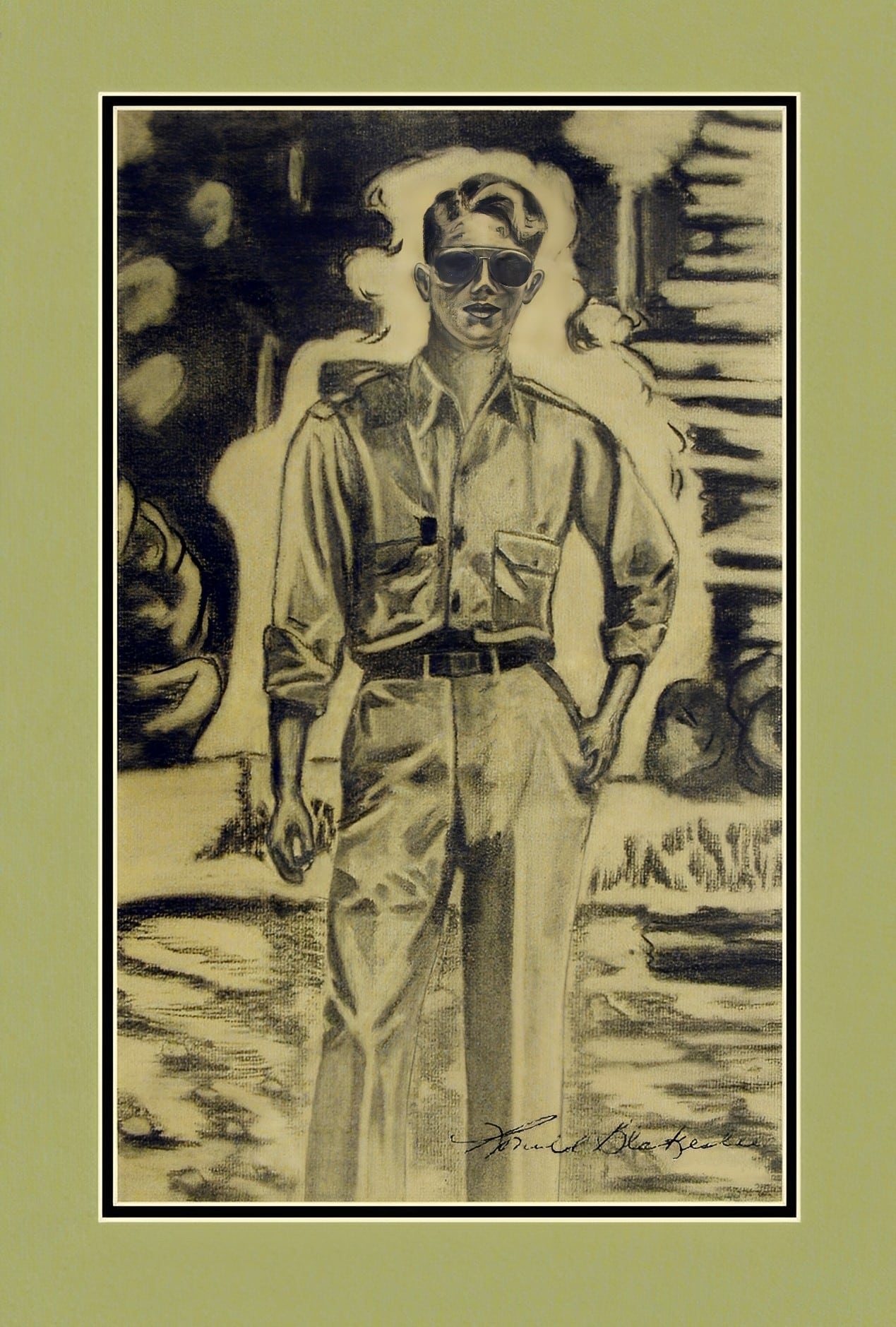
Ronnie idolized his older brother Leland. He was a talented artist with a quiet intensity. When news came that Leland was missing and presumed dead, Ronnie sat down with “The Picture” — a treasured image of his brother — and created a charcoal sketch from it.
When he finished the sketch, he made another decision. He enlisted in the United States Air Force.
Though his parents strongly discouraged it, Ron went anyway — determined to find his brother.
He volunteered for one of the most dangerous assignments in the military: COINS — Covert Operations and Insurgence. His role was to go behind enemy lines, evaluate the condition of downed pilots, and decide whether they could be brought out alive.
Ron never spoke much about what he saw. But the one and only time he was ever seen openly weeping and sobbing was the one and only time he talked about the COINS.
There was another side of Ron that not many people knew. From the time he was a young boy, he talked about adopting a child. Most people thought it was a little strange — but that never deterred him.
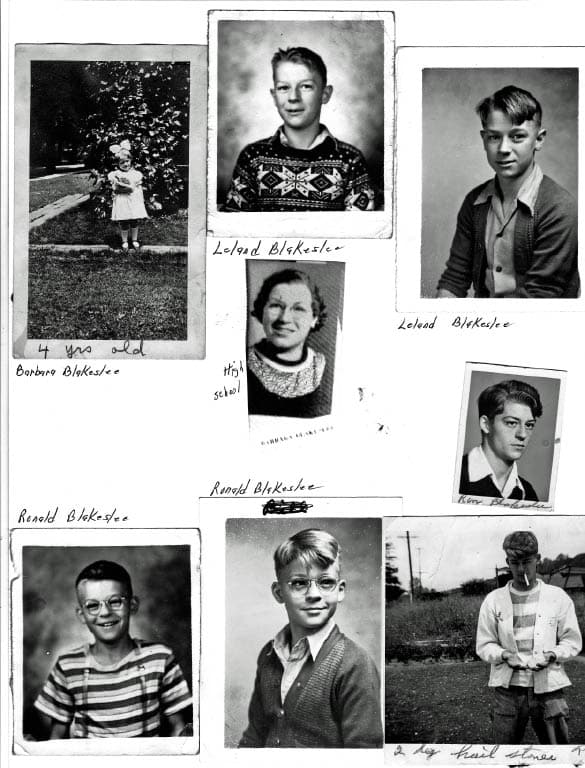
Ron married Shirley Jean Torrey on April 4, 1952. After finishing his USAF service, the couple welcomed a daughter on January 10, 1958: RoJean Diane Blakeslee. Her name was a blend of “Ro” from Ron and “Jean” from Shirley’s middle name — a perfect tribute to them both. Ron always had a creative side.
But after RoJean was born, Ron began talking about adoption again. This time, people found it even stranger — after all, they had just had a child of their own.
Still, Ron was undeterred.
One day, he picked up the phone and called the Allegany County Department of Social Services in Belmont, New York. They told him that when a child needed a home, they would call and invite him to “look the child over.”
Ron replied plainly:
“If I come over, there won’t be any ‘looking the child over.’ I’m bringing them home.”
And that’s exactly what he did.
Just after Christmas in 1959, Ron and Shirley brought their three-month-old son home. His name was Shane Michael Blakeslee.
The Choice
Shirley Jean Torrey was born on August 1, 1933, in Ceres, New York.
Her parents, Adrian and Nina Torrey, were struggling to stay afloat during one of the darkest years of the Great Depression.
Shirley was one of six children—Adrian, Bob, Bruce, Jerry Lou, and Tim.
They were a close-knit family that worked hard and played hard.
The Torrey kids excelled both in the classroom and on the field.
They were standouts at Bolivar Central School, where athleticism seemed to run in the blood. Bob’s son would later become a star running back at BCS, then play for Penn State and in the NFL.
Years later, when Shirley’s children were grown, they were asked what they remembered most about their mother.
Their answer came slowly—too slowly.
That hesitation was both frightening and disappointing.
Eventually, they reached a conclusion: their mom’s life was ordinary.
But let’s take a closer look at that “ordinary” life.
Shirley cooked. She cleaned. She sewed. She did laundry—including ironing (who even does that anymore?). She cleaned houses to supplement household income. She was the office manager for two local construction business simultaneously – Mazza Roofing and Crisafulli Construction, working there until the day before she died.
She hosted visiting dignitaries from the church.
She played both piano and organ.
She worked as an executive secretary at Dresser-Clark, the area’s largest employer.
She was wife to Ron.
Mother to RoJean, Shane, and Gregg.
Shirley was fierce—but she was kind and loving, too.
Just ask the boys. They’ll tell you about the time their sweet, loving, never violent, mother whacked one of them on the head with a cast iron sandwich maker. (there ought to be an 800 number for that.) Their dad, Ron, saw the whole thing. He asked them the same thing he always asked when they got into trouble: Did you learn anything? Still stunned, Shane and Gregg didn’t say anything. Ron then said: You should have learned that you should always steer clear of a woman in menopause. They really didn’t know what that meant, until later.
As high school graduation approached, Shirley faced a decision:
She could take the traditional path—devoted wife, stay-at-home mom, faithful church member dedicated employee
Or she could pursue the path of “importance.”
Shirley chose both.


The Trunk
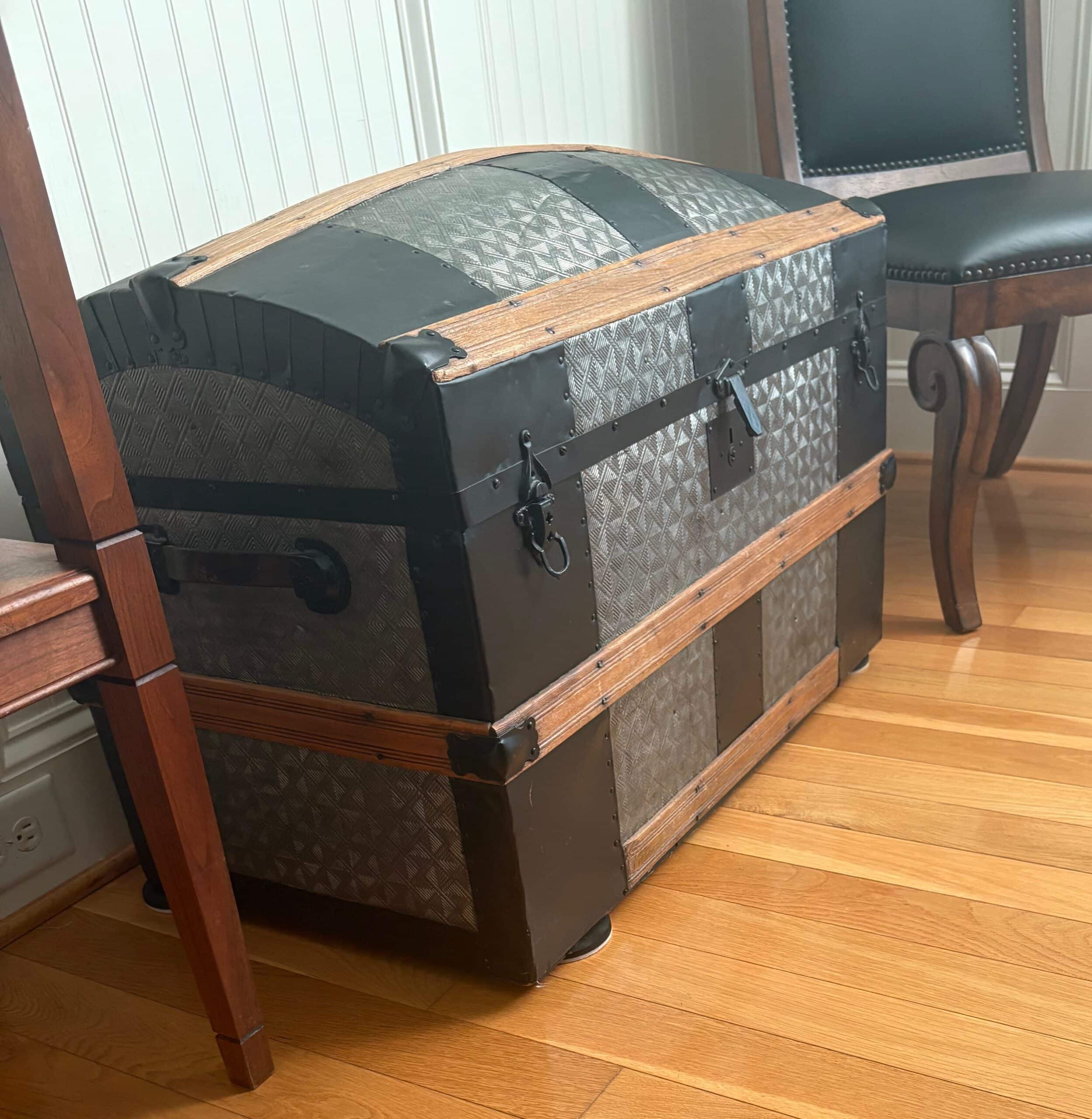
It was old. Worn. Rusted through.
Discovered off Transit Hill Road near Belmont, New York, the steamer trunk looked like it had weathered a century of storms. Its metal was coated in thick rust. The leather handles had long since crumbled. The wood trim was splintered and gray with age. Inside, it was in one word: toast.
And yet—it was impossible to ignore. The shape. The weight. The quiet dignity. Whoever left it there knew it meant something. Whoever picked it up couldn’t let it go.
Next stop: a funeral home. Yes, you read that right.
Spinks Funeral Home in Olean, NY—run by Ray Spink and his son Brad—had served the community for generations. The Spinks were known throughout Olean for their quiet kindness and unwavering integrity.
Behind the funeral home sat a three-bay garage. In the bay next to the hearse, a man named Steve Baldwin rented workspace. Steve wasn’t just good with machines—he was a mechanical genius. He could take a chunk of angle iron, an old engine block, and turn it into a roaring '68 Pontiac Firebird. Give him enough time, and he could bring almost anything back to life.
But Steve wasn’t just gifted—he was generous. He often opened his workspace and shared his tools with friends. That’s how The Trunk found its second chance. Sanded, cleaned, reinforced, and reborn.
Once restored, the trunk became something more than storage. It became the family archivist.
Inside it now rests a quiet treasury:
– Leland’s Bible, given to him by his mother.
– A charcoal sketch of Leland, drawn by his brother Ronnie.
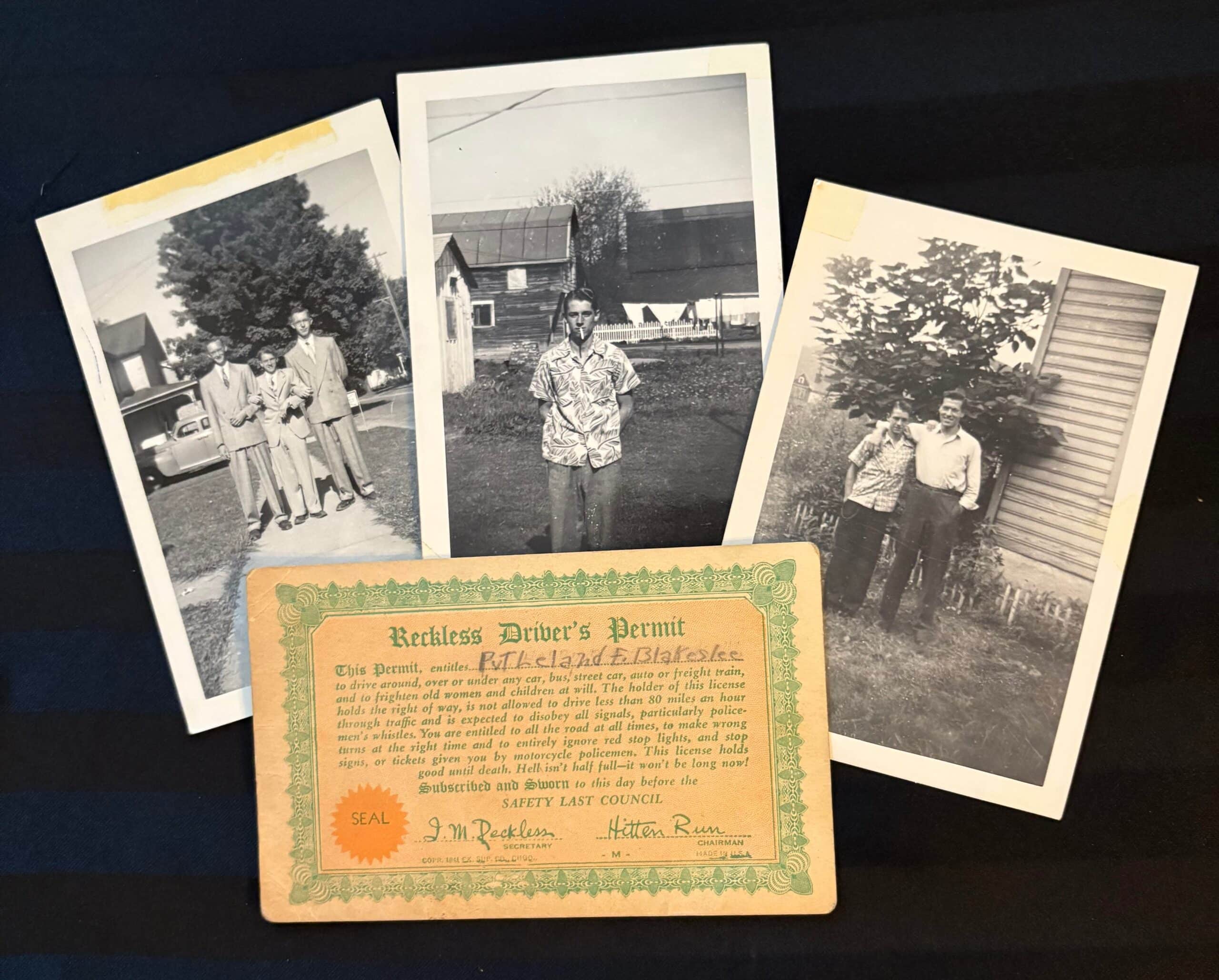
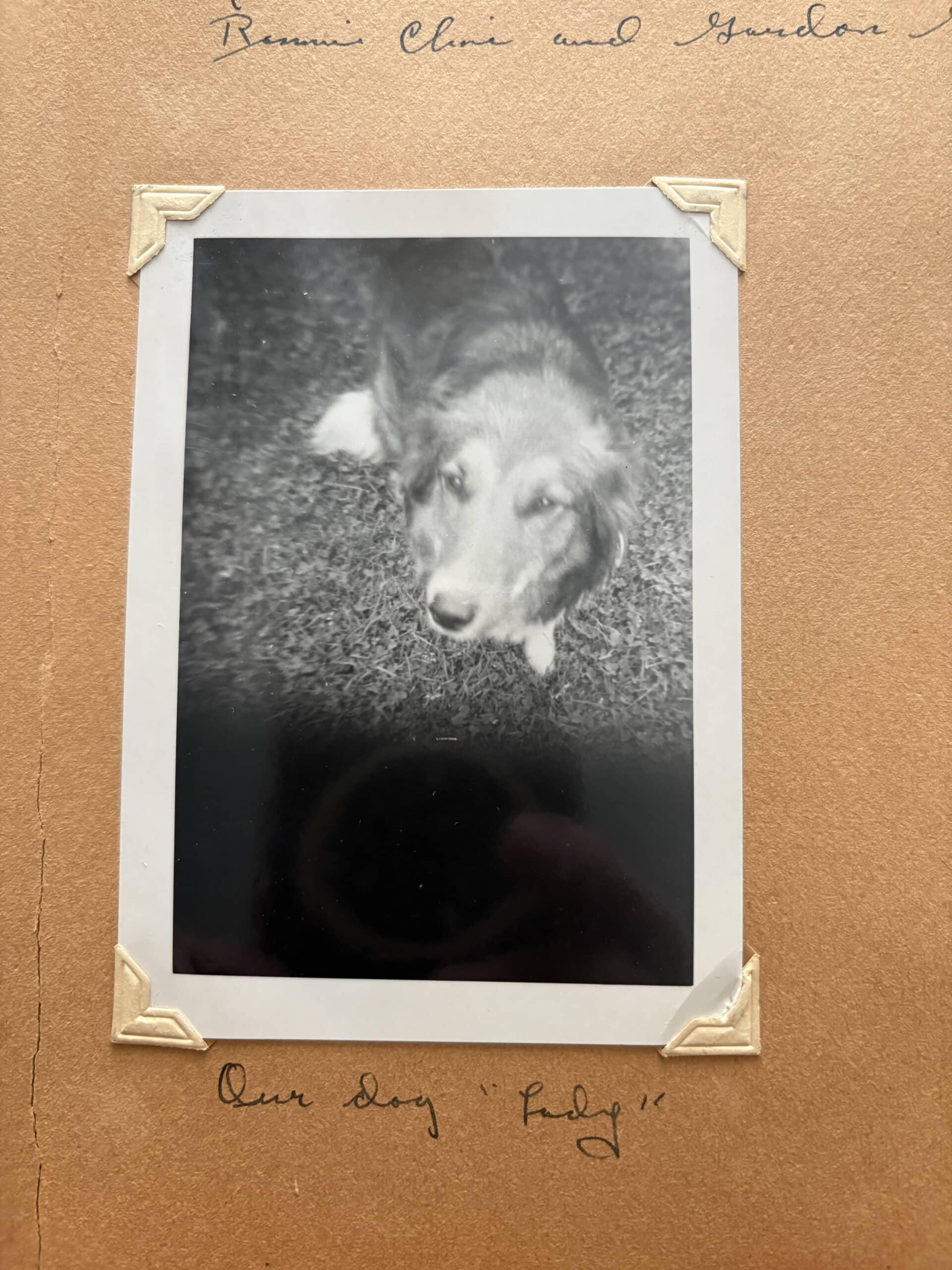
– Faded photographs: Leland’s sweetheart Helen. His mother Belle. His dog, Lady.
What was once rusted and forgotten by the roadside is now the keeper of a family’s most sacred pieces—transformed from rust to remembrance.




The Catch
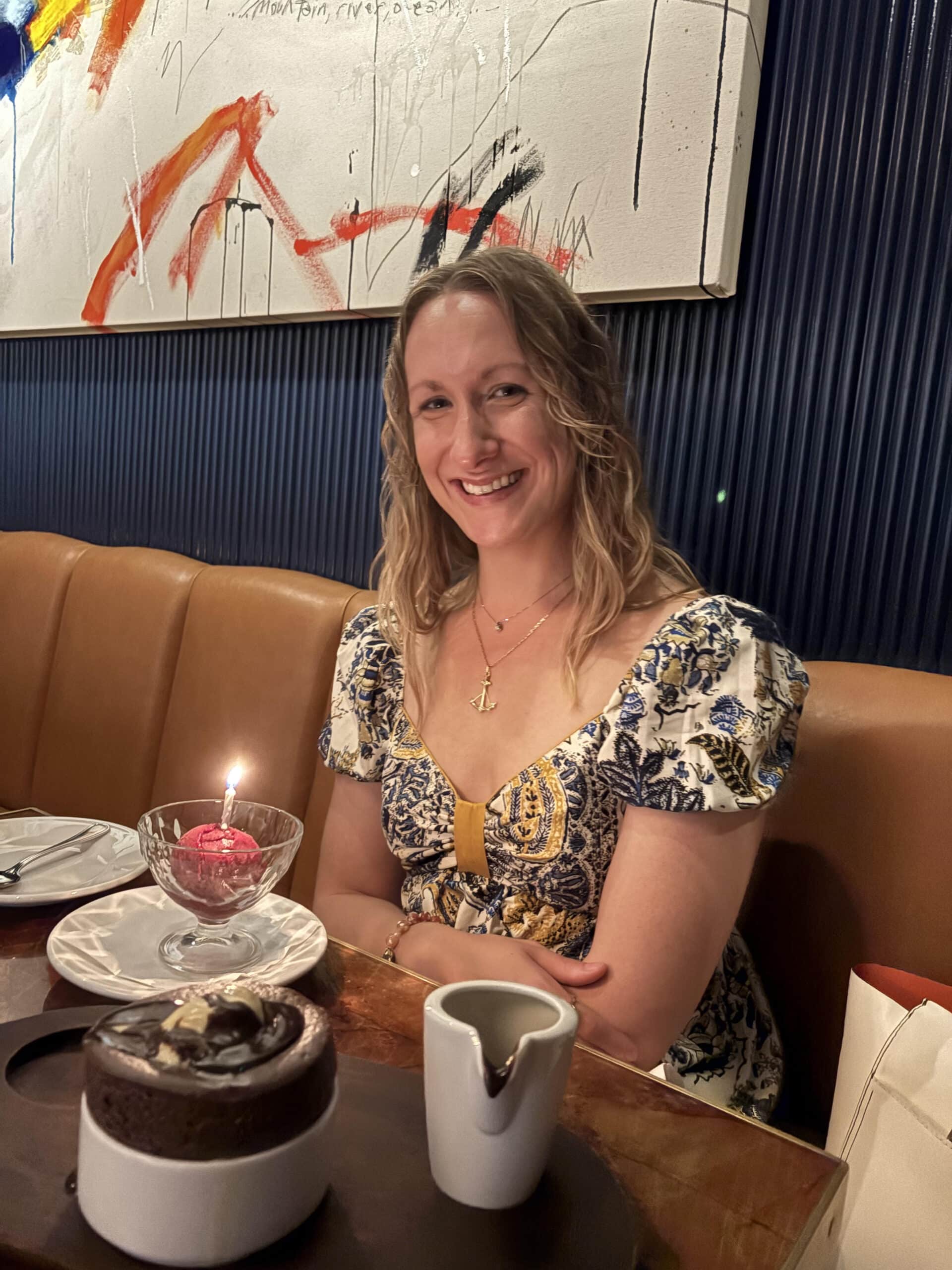
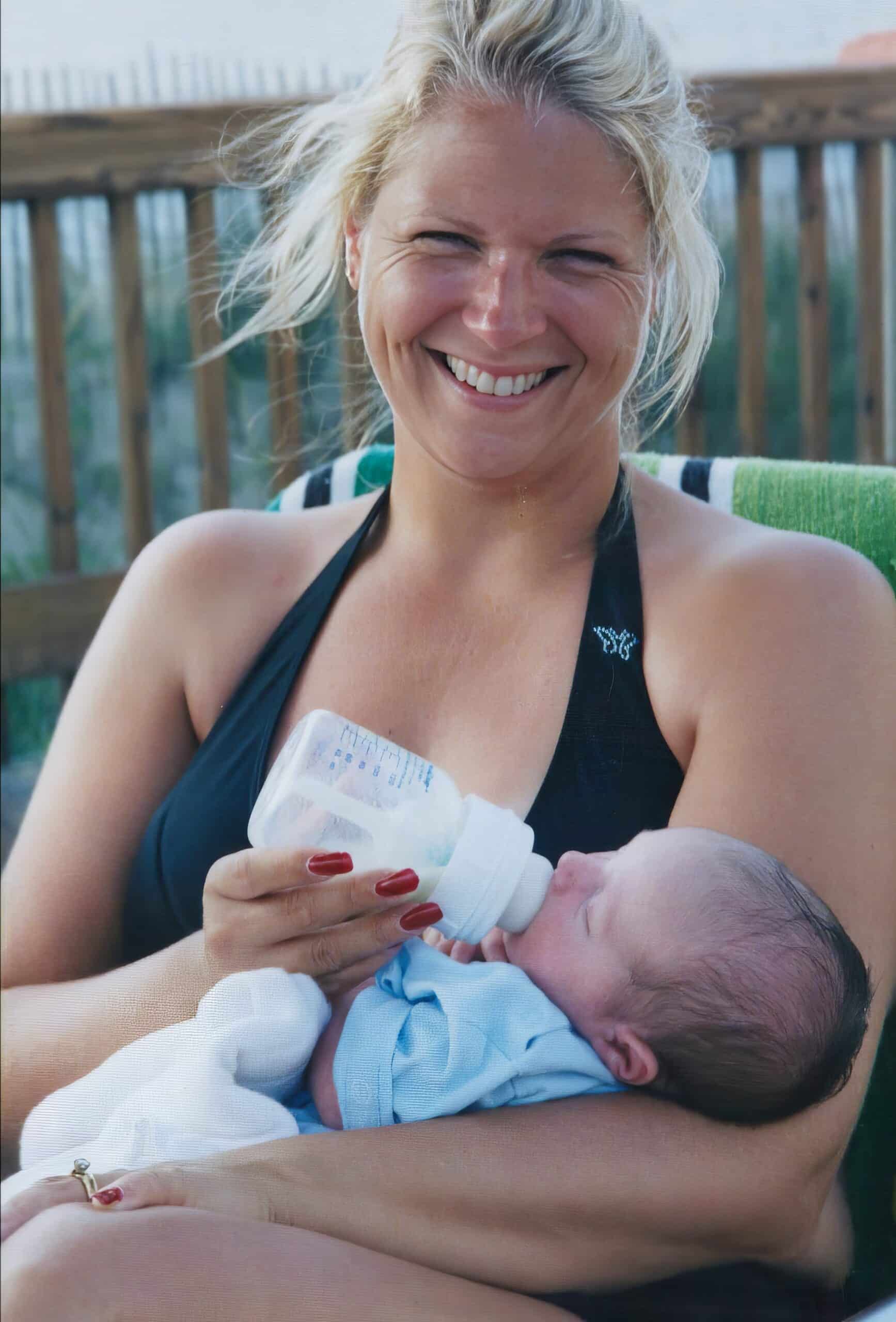
To my partner, wife, and best friend.
27 years of happiness and love.
Grateful for sharing our life together.
Forever my lovely bride.
The Glue
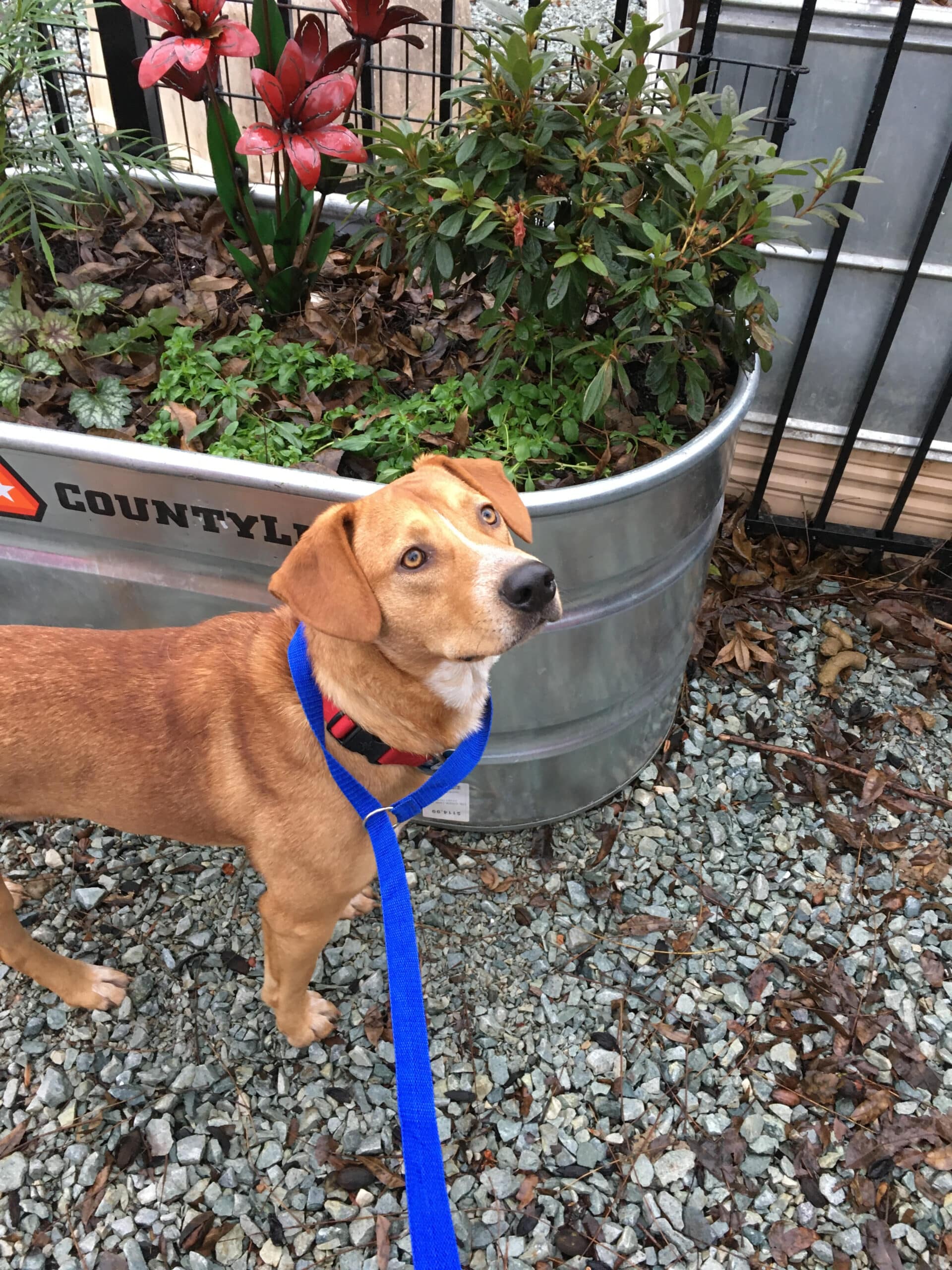
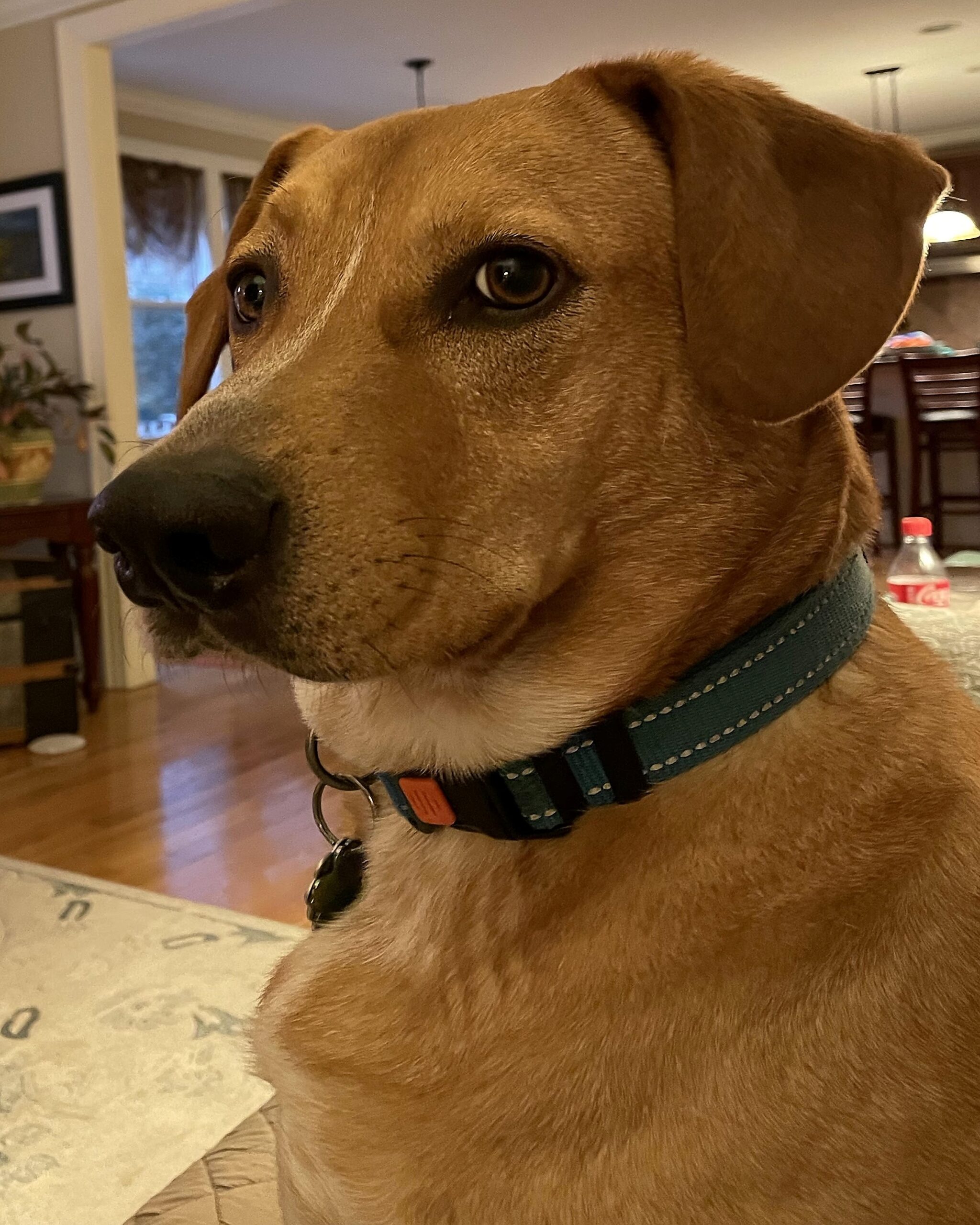
Dean’s not just the family dog. He’s the glue. The steady, warm, always-there kind of glue that holds everyone a little closer, even if they don’t realize it.
He’s six now—right in that sweet spot where he still loves to play, but he’s got this calmness to him too. A quiet wisdom. Dean sees everything, hears everything, and somehow makes it all feel okay. He’s got those deep, thoughtful eyes—like he understands more than he lets on. He doesn’t need words—just one look, and you feel it: unconditional love.
You’ll find him stretched out by the couch, curled up on the bed, or just sitting there watching the world go by, like he’s the unofficial guardian of the house. He doesn’t need to bark for attention. He just *is*, and that’s enough.
And the thing is, Dean brings people together. He’s the reason someone might come into the room just to give him a scratch, and then stay to talk. He’s the soft landing after a rough day. The cuddle buddy. The listener. The reason we all sit just a little closer.
He’s not loud. Not dramatic. Just... solid. Loving. Present.
That’s Dean. He’s the heart of the house, the best kind of glue—stuck to us in all the best ways.